

A man armed with a shotgun, a handgun and multiple knives charged a security checkpoint at the White House Correspondents’ Dinner Saturday night, triggering the evacuation of the President of the United States Donald Trump
By our Washington Correspondent | Global Echos | April 26, 2026
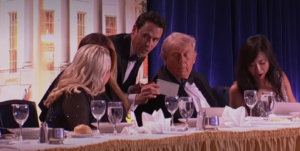 WASHINGTON. The room was mid-applause. Two thousand six hundred guests, among them journalists, cabinet secretaries, senators, and celebrities, were seated in the Washington Hilton’s grand ballroom on Saturday evening for what was supposed to be a night of ritual civility in an age of political warfare. Then came the shots.
At approximately 8:40 p.m. Eastern time, the evening collapsed. A suspect later identified as Cole Tomas Allen, 31, of Torrance, California, charged through the main magnetometer screening area outside the ballroom perimeter, fired what CNN anchor Wolf Blitzer, who was standing just feet away, described as “a very serious weapon” at least six times, and was brought down by Secret Service agents before he could reach the ballroom itself. Inside, agents shouted “shots fired.” The room erupted. Guests dove beneath tables. President Donald Trump was rushed off the stage by the Secret Service and held in a secure area of the hotel. First Lady Melania Trump, Vice President JD Vance, FBI Director Kash Patel, Secretary of State Marco Rubio, and Health and Human Services Secretary Robert F. Kennedy Jr. were among the senior officials evacuated. By 9:45 p.m., Trump had been returned to the White House.
One Secret Service officer was struck. He survived, saved by his bulletproof vest, as Trump later confirmed to reporters.
No other injuries were reported.
“I Fought Like Hell to Stay”
Speaking to reporters at a late-night White House press conference, Trump described himself as having resisted the evacuation. “I fought like hell to stay,” he said, a characteristic flourish that masked what those in the room described as a genuinely terrifying sequence of events. He confirmed that Allen had been armed with a shotgun, a handgun, and multiple knives, and characterised the suspect as a “lone wolf.” When asked whether he believed he had been the target, Trump paused. “I guess,” he said. “They’re asking him a lot of questions.”
It was not the first time Trump had faced an armed assailant. He survived an assassination attempt at a campaign rally in Butler, Pennsylvania, in July 2024, and a second incident months later at his Florida golf course. Saturday night marked the third occasion in under two years that deadly force had been directed, or allegedly directed, at the forty-seventh president of the United States.
Trump, who had boycotted the Correspondents’ Dinner throughout his first term, was attending for the first time as a sitting president. The historical irony was not lost on those present: the very evening designed, in part, to symbolise the working relationship between the White House and a free press had become, in its final moments, a federal crime scene.
The Suspect: A Profile Takes Shape
Federal investigators moved with unusual speed. By the early hours of Sunday morning, FBI agents had assembled outside a residential address in Torrance, a quiet Los Angeles suburb, connected to Allen. The scene drew a large crowd of media and onlookers as agents worked through the night.
US Attorney for the District of Columbia Jeanine Pirro confirmed at a late press conference that Allen faces two initial federal charges: using a firearm during a crime of violence, and assault on a federal officer with a dangerous weapon. He is scheduled to be arraigned on Monday. Pirro indicated further charges are likely to follow.
CBS News reported that Allen told authorities he had been targeting officials from the Trump administration, though investigators cautioned that motive is still being formally established. A retired FBI supervisory special agent, briefed on the investigative procedure, told reporters that authorities had by Saturday night already run Allen’s name through criminal history databases, military service records, mental health flags, travel records, and known associates. The mayor of Torrance, George K. Chen, issued a statement condemning the attack and describing Allen’s connection to the city as “deeply troubling.”
A Security Failure at the Highest Level
Beyond the immediate drama, Saturday night raises serious and uncomfortable questions about the security architecture protecting the most concentrated gathering of senior US government officials outside a formal state occasion.
The Washington Hilton is not the White House. Its lobby, as the Associated Press noted, remains open to other hotel guests during the dinner, and the primary security screening is positioned closer to the ballroom than to the building’s public entrances. Former FBI deputy director Andrew McCabe, speaking before the incident, had described the event’s security as “almost on the level of a national security event,” given the concentration of cabinet officials in a single room. Saturday night’s events suggest that assessment was optimistic.
The fact that Allen was carrying a shotgun, a handgun, and multiple knives, and was nonetheless able to approach the main magnetometer area, will be the subject of intensive review. The Secret Service confirmed in an official statement that it is investigating in coordination with the Metropolitan Police Department. Questions about how Allen reached the checkpoint with that level of armament, and what, if anything, was known about him in advance, may take weeks to answer fully.
The venue itself carries a grim historical echo. Forty-five years ago, John Hinckley Jr. attempted to assassinate President Ronald Reagan as he emerged from the same Washington Hilton. That precedent did not go unmentioned on Saturday night, and it will not go unmentioned in the weeks of congressional inquiry that are almost certain to follow.
A World Watching
International reaction was swift and largely uniform in tone. Canadian Prime Minister Mark Carney said he was “relieved that the President, the First Lady, and all guests are safe,” adding that “political violence has no place in any democracy.” European Commission President Ursula von der Leyen expressed gratitude to security services for their “swift action.” The EU’s foreign policy chief Kaja Kallas offered what may prove to be the evening’s most resonant observation: “An event meant to honour a free press should never become a scene of fear.”
Leaders from Italy, Spain, Portugal, Greece, Ireland, Ukraine, Estonia, the Netherlands, Albania, Latvia, Kosovo, and Lithuania also issued statements of condemnation and relief.
Trump’s own response returned, before long, to political terrain. He used his press conference remarks to suggest the Washington Hilton was insufficiently secure and cited the incident as further justification for his longstanding push to build a dedicated White House ballroom. He also dismissed any link between the shooting and the ongoing US-Iran conflict. “It would not stop him from winning the war in Iran,” he said.
Outside the Hilton on Saturday evening, among the protesters who had gathered, one carried a sign that read: Journalism is dead.
After the night Washington just witnessed, it is the security of those who remain alive to practice it that will now demand the country’s urgent attention.
Global Echos Washington Bureau. Cole Tomas Allen remains in federal custody and is expected to be arraigned Monday. The Secret Service, FBI, and Metropolitan Police Department are continuing their investigations. Motive has not been formally confirmed. This story is developing.
