

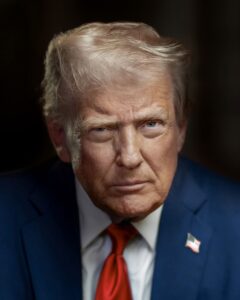
 By any historical or constitutional standard, the question of whether Donald J. Trump could seek a third presidential term is settled law. Yet it continues to surface sometimes jokingly, sometimes provocatively, because it speaks less to legal feasibility and more to Trump’s political method, his relationship with institutions, and the anxieties of a polarized American democracy.
This article examines the issue through three lenses: constitutional law, Trump’s political behaviour, and the real-world constraints imposed by U.S. institutions.
The constitutional barrier: clear, deliberate, and binding
The principal legal obstacle to a third term is the 22nd Amendment to the U.S. Constitution, ratified in 1951 in the aftermath of Franklin D. Roosevelt’s four electoral victories. The amendment states unequivocally: “No person shall be elected to the office of the President more than twice” (U.S. Const. amend. XXII).
The language is neither ambiguous nor conditional. It was drafted precisely to prevent the concentration of executive power in a single individual and to restore the two-term norm that had existed since George Washington. Legal scholars across the ideological spectrum agree that the amendment creates an absolute bar on a third election to the presidency (see Tribe, American Constitutional Law; Amar, America’s Constitution).
Repealing or amending the 22nd Amendment would require either a two-thirds vote in both houses of Congress or a constitutional convention called by two-thirds of the states, followed by ratification from three-quarters of the states (U.S. Const. art. V). Given modern polarization and bipartisan support for term limits, this threshold is functionally unreachable.
Trump’s rhetoric: norm-testing as political strategy
Despite all the known constitution facts and constraints, Donald Trump’s history suggests that references to a third term, when they occur, should be understood as strategic rhetoric rather than operational intent. Throughout his political career, and more recently, Trump has repeatedly floated ideas that test democratic norms, questioning judicial legitimacy, casting doubt on electoral integrity, and suggesting expanded executive authority, without necessarily following through when institutional resistance becomes insurmountable.
This pattern was evident after the 2020 election, when Trump pursued numerous legal challenges but ultimately complied with formal transfer-of-power requirements after institutional avenues closed. Courts, including those with judges appointed by Trump himself uniformly rejected claims that sought to overturn certified results (e.g., Trump v. Wisconsin Elections Commission, 2020).
In this context, third-term rhetoric serves multiple purposes: it reinforces Trump’s image as indispensable to his movement, pressures Republican elites to demonstrate loyalty, and keeps political opponents reactive. Crucially, it also frames constitutional limits as political choices rather than binding law a narrative consistent with populist challenges to liberal-democratic institutions.
The myth of constitutional “workarounds”
Several speculative scenarios are often raised in public discourse, none of which survive legal scrutiny.
One involves Trump running as vice president and later assuming the presidency. However, the 12th Amendment explicitly bars individuals constitutionally ineligible for the presidency from serving as vice president (U.S. Const. amend. XII). Legal consensus holds that a twice-elected president is constitutionally ineligible and therefore disqualified from the vice presidency as well.
Another theory imagines Trump governing through a proxy, supporting a loyal successor while exercising informal control. While this is politically conceivable, it is not unprecedented and does not constitute a third term. Informal influence lacks the constitutional authority, legal immunity, and command structures vested in the presidency itself.
Finally, emergency rule is sometimes invoked. Yet U.S. emergency powers do not suspend constitutional amendments, nor do they nullify term limits. Even during wartime, courts have continued to assert constitutional supremacy (see Youngstown Sheet & Tube Co. v. Sawyer, 1952).
Institutional resistance: the underestimated factor
The durability of the American system lies not in any single institution but in the redundancy of constraints. Ballot access is administered by state officials; elections are certified at state and federal levels; courts adjudicate eligibility; Congress counts electoral votes; and the military is bound by constitutional civilian control.
For a third Trump term to materialize, all these actors—including opposition-controlled states, independent courts, and career officials—would need to acquiesce. There is no empirical evidence to suggest such coordinated institutional failure is plausible.
Moreover, Republican Party elites would face severe legal and electoral consequences for endorsing a plainly unconstitutional candidacy. Historically, even highly partisan actors have retreated when constitutional lines were unmistakable.
Political reality versus political theatre
Trump’s strength has always been theatrical dominance rather than institutional capture. He excels at shaping narratives, mobilizing grievance, and projecting inevitability. But when confronted with fixed constitutional limits, his record shows eventual retreat rather than sustained confrontation.
Public opinion further constrains the issue. Term limits enjoy broad support across party lines, and any serious attempt to override them would likely provoke a public backlash comparable to, or exceeding, the reaction to the events of January 6, 2021 (see U.S. House Select Committee Report, 2022).
Conclusion: a legal impossibility with political utility
From an investigative and constitutional standpoint, the prospect of Donald Trump serving a third elected term is not merely unlikely, it is legally foreclosed. The 22nd Amendment was designed precisely to prevent such outcomes, and the institutional architecture of the United States remains robust enough to enforce it.
That said, the persistence of the question is revealing. It underscores how modern American politics increasingly operates in the space between law and perception, where rhetorical provocation can shape discourse even when outcomes are predetermined.
In that sense, the third-term debate is less about Trump’s future in office and more about the ongoing stress test of American constitutional democracy itself.
