

Labour’s worst local election results in decades trigger cabinet resignations and growing calls for the Prime Minister to stand aside
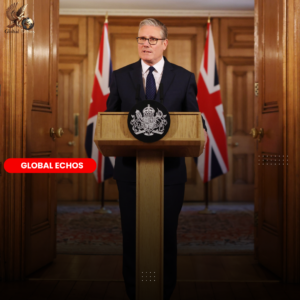 LONDON: Britain’s political landscape was convulsed this week as Keir Starmer’s Labour government staggered into its deepest crisis since taking power in 2024, battered by a seismic set of local election results that handed Nigel Farage’s Reform UK party an extraordinary surge of popular support and left Downing Street fighting for its survival.
The scale of the damage was historic. Labour shed more than 1,400 council seats across England, losing control of over 30 councils including once-safe strongholds such as Southampton, Oxford, Exeter, Wandsworth, and Hartlepool. In Wales, the party’s grip on the Senedd, a dominance it had held for decades, was broken, with Plaid Cymru emerging as the largest party. Taken together, the results were the worst the party had endured in a generation.
The beneficiary above all was Reform UK. Farage’s insurgent right-wing populist party gained over 1,400 seats in England alone, seizing control of councils including Essex, Havering (its first foothold in London), Newcastle-under-Lyme, Suffolk, and Sunderland. In working-class communities across the north of England that had voted Labour loyally for generations, Reform swept the board. Farage, who heralded the results from Romford as a “historic shift in British politics”, declared that the old two-party system was finished.
The electoral earthquake triggered immediate aftershocks inside the Labour Party. Within days, more than 70 Labour MPs had publicly called on Starmer to resign or at minimum to set out a clear timetable for his departure. Home Secretary Shabana Mahmood, one of the most senior voices in the cabinet, became the highest-profile figure to openly demand that the Prime Minister stand aside.
The first ministerial resignation came on Tuesday with the departure of Miatta Fahnbulleh, a junior minister in the housing and communities department. By early afternoon, two further junior ministers had quit, signalling that the pressure from below was translating into tangible institutional fracture. Several more ministerial aides had already walked away the previous evening, after Starmer’s high-stakes address to Labour colleagues on Monday failed to offer the bold policy reset that critics were demanding.
Former deputy prime minister Angela Rayner, who resigned from her post last year over a tax affair, added fuel to the fire, posting on social media that Labour’s approach “isn’t working” and warning ominously: “This may be our last chance.” Labour-affiliated trade unions echoed the sentiment. Unite general secretary Sharon Graham declared that “the writing is on the wall”, while Unison’s Andrea Egan warned the party faced “political oblivion” unless it fundamentally changed course.
Despite the mounting pressure, Starmer has shown no public willingness to go. In a speech to Labour supporters on Monday, he acknowledged “doubters” within his own ranks and accepted personal responsibility for the heavy defeats. But he framed any change of leadership as a descent into “chaos”, pointing to the revolving door of Conservative prime ministers that preceded him. “What we witnessed with the last government was the chaos of constantly changing leaders, and it cost this country a huge amount,” he said.
His cabinet has not been entirely deserted. Deputy Prime Minister David Lammy counselled the party not to “change the pilot during the flight”, and Starmer’s office issued a terse statement insisting the party’s formal leadership challenge process had not been triggered. Under Labour’s rules, 81 signatures (a fifth of the parliamentary party) are required to force a leadership election among the membership.
Analysts are deeply sceptical. Political risk consultancy Eurasia Group has assessed the most likely scenario as Labour MPs forcing a leadership election by September, with a 35% probability. An orderly transition, in which Starmer agrees a timetable for departure, is rated at 25%, with an immediate leadership contest at 20%. The assessment is blunt: “Although he may remain a few more months in Downing Street, he is still fighting for his political life.”
Yet the path to removing Starmer is far from clear-cut. Labour has no tradition of regicide; the party has never mounted a formal leadership challenge against a sitting prime minister. Crucially, there is no consensus on a successor. The names most frequently cited, namely Health Secretary Wes Streeting, Greater Manchester Mayor Andy Burnham (who would first need to win a parliamentary seat), and the rehabilitated Rayner, each carry significant baggage or face practical obstacles.
There is also the broader political picture to consider. The fragmentation of the British electorate is not simply a Labour problem. The Conservatives lost over 500 seats, and the results illustrated a country fracturing along multiple axes: Reform commanding the populist right, the Greens absorbing disaffected urban progressives, the Liberal Democrats picking up soft Conservative voters, and nationalist parties dominant in Scotland and Wales. For all the immediate focus on Starmer, Labour faces a structural challenge that no single leader change will solve.
The uncomfortable irony for Starmer is that it was Nigel Farage who, more than any other figure, engineered his destruction. Farage, whose Brexit project paradoxically created the conditions for Labour’s 2024 landslide, has now weaponised the disappointment of voters who hoped Labour would do more. The same working-class communities that turned to Labour in their millions only two years ago have now turned to Reform instead, a dizzying political reversal that speaks to just how volatile British politics has become.
Starmer’s immediate challenge is to hold his cabinet together and survive the week. His longer-term challenge (which may no longer be his to face) is to offer a convincing answer to a public that wanted dramatic change and received instead careful managerialism. Whether he gets the chance to make that case, or whether Labour concludes he cannot, will likely be determined in the coming days.
