

EDITOR’S NOTE: This investigation by a group of Global Echos Investigative journalists, draws on the ICIJ Offshore Leaks Database, WikiLeaks diplomatic cables, OCCRP investigations, French investigative reporting by Nouvel Observateur, Cameroonian intelligence sources, and publicly available company registry data from France, the British Virgin Islands, and Cameroon. The inclusion of any entity in the ICIJ Offshore Leaks Database does not, in itself, constitute evidence of illegal conduct. Where allegations are made, they are attributed to their source. All named individuals and entities have been given the opportunity to respond, though none have done so on the record.
By Global Echos Investigative Desk | Global Echos | May 22, 2026
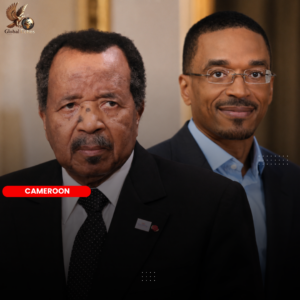 Paul Barthélemy Biya’a bi Mvondo has governed Cameroon since November 1982, making him the longest consecutively serving non-royal head of state on earth. He is 93 years old. He has never publicly declared his assets, in direct violation of Article 66 of Cameroon’s own constitution. His country ranks 142nd out of 182 nations on Transparency International’s 2025 Corruption Perception Index. And yet, by any measure available to outside investigators, the Biya family controls a financial network that stretches from the oil fields of the Cameroonian coast to the 16th arrondissement of Paris, from the penthouse suites of the InterContinental Hotel in Geneva to the sun-bleached hillsides above Monaco.
This is what the public record reveals.
THE STATE AS PERSONAL BANK: OIL, THE SNH, AND THE PRESIDENCY
The most consequential institution in Biya’s financial architecture is not a company or a trust. It is a state body: the Société Nationale des Hydrocarbures (SNH), Cameroon’s national oil corporation. The SNH has not made public any of its contracts or competitive bids. The presidency controls it directly: the long-standing Secretary-General of the Presidency also chairs the SNH board of directors. Several expenses of the presidential family are paid directly through this company.
The arrangement’s implications are staggering. According to an investigation by the Organised Crime and Corruption Reporting Project (OCCRP), the International Monetary Fund found that more than $300 million of SNH’s revenue in 2017 alone was entirely unaccounted for. A leaked US diplomatic cable published by WikiLeaks confirms that oil sales from the SNH have ‘historically been used as a slush fund.’ A second WikiLeaks cable, from June 2008, reveals that when Biya wanted a Boeing Business Jet for personal use in 2001, the $31 million required was wired from an SNH account to a US-based intermediary company called GIA, ostensibly routed through the national airline Camair to avoid detection by international financial institutions.
The Glencore scandal added further texture to the SNH’s role as a conduit. When the UK Serious Fraud Office concluded its investigation of the Swiss commodities giant, Glencore admitted that between 2006 and 2014, one of its subsidiaries paid at least $21 million in bribes to Cameroonian government officials in oil trading contracts. In 2022, the UK court passed judgement on Glencore’s UK subsidiary, fining it £276 million after it pleaded guilty to widespread, endemic bribery spanning several African countries, including Cameroon. Glencore admitted that its London-based West Africa oil desk actively used intermediaries to pay millions of dollars in bribes to officials at state-run entities in Cameroon, notably SNH (National Hydrocarbons Corporation) and SONARA (National Oil Refinery), to secure preferential access to crude oil. Strangely, not a single Cameroonian official has been prosecuted in connection with the Glencore bribes.
Most recently, in April 2025, whistleblower reports and internal audits traced the disappearance of at least five oil shipments from SNH, allegedly siphoned through a covert offshore operation with an estimated value of $230 million. SNH Director General Adolphe Moudiki, a close confidant of President Biya who has held the post since 1993, denied wrongdoing.
THE OFFSHORE LAYER: PANAMA PAPERS AND BIYA HOLDINGS LIMITED
The ICIJ’s Offshore Leaks Database contains a direct entry: BIYA HOLDINGS LIMITED, identified as a Panama Papers entity. The database covers entities established over more than 80 years up to 2020 and links to people and companies in more than 200 countries and territories. The ICIJ does not allege illegality from inclusion alone, and Biya Holdings Limited’s beneficial ownership has not been publicly confirmed as belonging to the president’s immediate family. What is confirmed is that a corporate entity bearing the family name was created through the Mossack Fonseca network, the same firm that enabled the hidden wealth of 12 current or former world leaders globally.
The ICIJ database also contains a separate entry for Abba Biya – Nejib, another node in the offshore mapping. The precise relationship of this entity to the president’s family has not been established in published investigations to date. Both entries are available for public inspection at offshoreleaks.icij.org.
REAL ESTATE IN FRANCE: 744 MILLION EUROS AND A PAPER TRAIL
The most detailed forensic accounting of the Biya family’s European property portfolio comes from a landmark 2022 investigation published in Nouvel Observateur entitled ‘Luxury Real Estate: How France Attracts Dubious Money from Around the World.’ The investigation, conducted by five French investigative journalists, identified 62 individuals connected to the Biya family and inner circle who spent, between 1985 and 2020, more than 744 million euros purchasing real estate across France.
Chantal Biya, the First Lady, has never held formal employment. Yet she registered a company in France through which she spent more than 2 million euros acquiring three apartments , in the 16th arrondissement of Paris, in Levallois-Perret, and in Nice , between 1997 and 2009. Two of the purchases were made in cash. The third was financed by a loan from BNP Paribas. The acquisitions were facilitated through a Cameroonian senator and notary, Pierre François-Xavier Menye Ondo, who held a nominal 1% share in two of the three purchases, serving as a legal front.
Franck Emmanuel Biya, the president’s eldest son and whose name is repeatedly featuring in the debate on Biya’s successor, purchased a luxury villa near Monaco’s Cap-Martin in 2004 at the age of 33, for nearly 3 million euros. The property features a swimming pool and sits within a gated private estate. When French financial authorities inquired about the source of the funds, Franck Biya did not respond.
FRANCK BIYA’S CORPORATE EMPIRE
Franck Biya has constructed a business portfolio that spans forestry, banking, engineering, and investment, always with the silent advantage of his father’s presidency behind it.
I.N.G.F. (Industrie Nationale de Gestion Forestière): From 1997 to 2004, Franck Biya was a partner in this forestry conglomerate. In 2004, the French NGO Survie accused INGF of illegally clearing 1,800 hectares of protected forest. The company was subsequently liquidated.
Afrione Cameroun: In 2012, the company was cited in a case of embezzlement of public funds. Afrione Cameroun also reportedly purchased bonds issued by two Cameroonian public bodies, raising concerns about the blurring of public and private interests.
Venture Capital PLC: Established in 2004, this is Franck Biya’s principal investment vehicle, with interests in banking, forestry, and energy across Africa and beyond. It facilitated Franck Biya’s reported involvement in the 2022 negotiations for Afriland First Bank’s expansion into Chad.
South Cameroon Hévéa: In 2020, Greenpeace identified Franck Biya as a minority shareholder in this subsidiary of global rubber giant Halcyon. Greenpeace accused the company of deforesting several thousand hectares of forest in southern Cameroon. Franck Biya did not respond to the allegations.
Franck Biya’s key business intermediaries include Christian Mataga and Ghislain Samou Nguewo, described by The Africa Report as ‘business angels’ who act as connective tissue between the Biya family and commercial opportunity. Philippe Mataga controls the Société Commerciale Industrielle et Forestière (Scifo), which holds forestry concessions granted by the Cameroonian Ministry of Forests.
THE COST OF THE PRESIDENCY: SWITZERLAND AND THE PUBLIC PURSE
An OCCRP investigation, published in 2018 and supported by 35 years of the government’s own Cameroon Tribune newspaper, calculated that Paul Biya had spent at least four and a half years on ‘private visits’ abroad since taking office. His preferred destination is the InterContinental Hotel in Geneva, where he occupies top-floor suites at an estimated cost of $50,000 per night, including his entourage of up to 50 people. The OCCRP calculated that the cost of Biya’s flights alone since 1982 could total at least $117 million.
In 2009, a French holiday alone reportedly cost $40,000 per day, consuming 43 hotel rooms.
THE PATTERN AND ITS IMPLICATIONS
What emerges from this investigation is not a single smoking-gun account but a structural picture: a presidency that has used the state oil company as a de facto private treasury, facilitated property acquisition in France through nominee corporate structures, generated offshore entities in known secrecy jurisdictions, and constructed a dynastic business network through a son who could possibly succeed him, thus acquiring constitutional power.
David Wallechinsky ranked Paul Biya alongside Robert Mugabe, Teodoro Obiang Nguema Mbasogo, and King Mswati of Eswatini as among the most corrupt rulers on earth. Article 66 of Cameroon’s 1996 constitution requires every senior official to declare their assets before assuming office. Paul Biya, in 44 years of power, has never done so.
The Pope, visiting Yaoundé in April 2026, told Biya directly to examine his ‘conscience’ and break ‘the chains of corruption.’ The palace issued no response.
The files are open. The money is findable. What is missing is the will , in Cameroon and in the jurisdictions that have facilitated this wealth , to follow it to its source.
————————————————————————————————–
Global Echos submitted detailed questions to the Presidency of Cameroon, the SNH press office, and representatives of Franck Biya. No responses were received at time of publication.
Sources: ICIJ Offshore Leaks Database | OCCRP | WikiLeaks Diplomatic Cables | Nouvel Observateur | The Africa Report | Transparency International | IMF | Cameroon Intelligence Report | Greenpeace
