From Lagos refineries to Ethiopian fertiliser fields and a landmark multi-exchange IPO, Aliko Dangote is executing the most ambitious private-sector expansion Africa has ever seen. Global Echos investigates what is driving it, and what it means for 1.4 billion people.
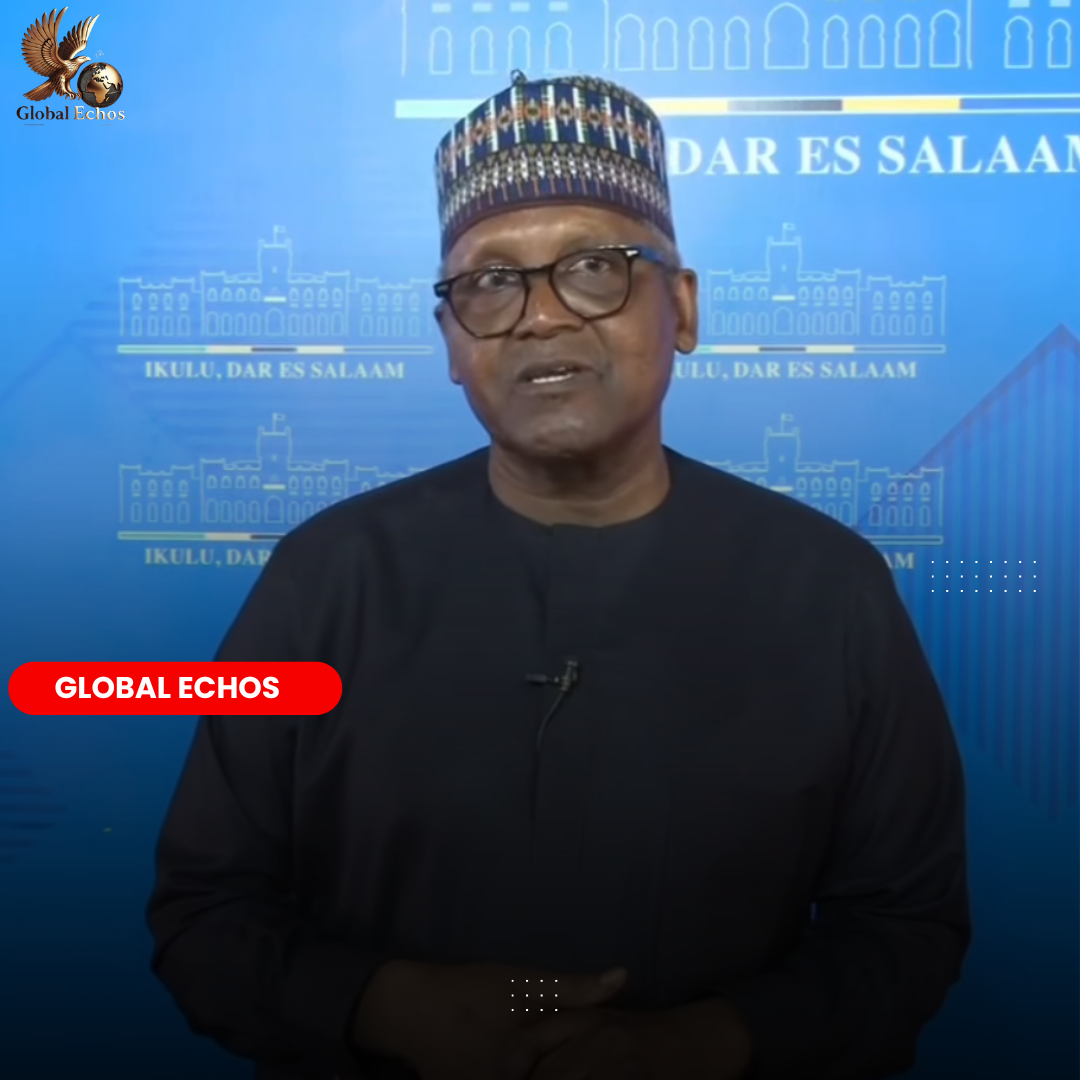 On a Tuesday in May 2026, inside Nairobi’s Kenyatta International Convention Centre, French President Emmanuel Macron unveiled a $27 billion investment package for Africa before thirty heads of state, then made the startling request that African wealth should consider investing in France. Seated quietly among the audience was a 69-year-old Nigerian industrialist in a white kaftan who, by that point in the year, had already added nearly $6 billion to his personal fortune. His name, of course, was Aliko Dangote. And he was not there to invest in France.
Dangote is, by every credible measure, the richest person on the African continent. According to Forbes, he has held that position for more than fifteen consecutive years. His net worth currently stands at approximately $28.5 billion on the Forbes list, though the Bloomberg Billionaires Index has tracked it as high as $35.9 billion in recent weeks following a sharp surge in the share price of his flagship company, Dangote Cement, which has risen nearly 69 percent since March 2025. The cement giant doubled its profits in 2025, recording a historic one trillion naira. That, however, is only the beginning of the story.
Vision 2030: A $100 Billion Ambition
On 31 March 2026, Dangote walked into the boardroom of the African Export-Import Bank in Cairo and presented what may prove to be the most consequential business plan in African corporate history. The strategy, titled Vision 2030: Supercharging Dangote Group for Long-Term Success, sets out a two-phase expansion running from 2025 to 2028 and 2028 to 2030, requiring at least $40 billion in fresh investment. The declared target is $100 billion in annual revenue by 2030, more than triple the group’s current scale.
The ambition runs across nearly every sector of the real economy. The Dangote Petroleum Refinery in Lekki, Lagos, already the largest single-train refinery in the world at 650,000 barrels per day, is earmarked for expansion to 1.4 million barrels per day. Fertiliser production is set to quadruple from 3 million to 12 million tonnes annually, a scale that would position Dangote Group as the world’s largest urea producer. Beyond those headline figures, the plan extends into gas infrastructure, ports, pipelines, power generation, mining, and data centres. The logic is unflinching: Africa cannot industrialise without reliable infrastructure, and Dangote intends to build it himself.
Nigeria First, Then the Continent
The refinery that reached full operational capacity in early 2026 was itself a decade-long, $20 billion project that rewrote Nigeria’s economic identity. For generations, Nigeria produced crude oil and imported refined fuel, one of the great contradictions of African resource economics. Dangote ended that. By early 2026, Nigeria had become a net petrol exporter, with jet fuel exports surging to destinations across Europe and West Africa. The refinery now supplies close to 80 percent of Nigerian fuel demand.
The fertiliser plant in Lagos, meanwhile, is already the largest single-train urea facility in Africa and one of the largest anywhere on earth. Dangote has used it as a template, systematically replicating the model in new markets. Cement opens the door. Sugar and fertiliser follow. Infrastructure investment deepens the roots. The sequence has proven itself in Nigeria. Now it is being rolled out across twelve countries.
Ethiopia: The New Flagship Frontier
The scale of Dangote’s continental push is perhaps most visible in Ethiopia. During a visit to the Somali region of the country, where he was received by Prime Minister Abiy Ahmed at the site of a proposed fertiliser plant, Dangote disclosed that total investment commitments in Ethiopia have now exceeded $4 billion, up from an earlier figure of $2.5 billion. Ethiopia is now ranked second only to Nigeria as a destination of Dangote Group investment, accounting for nearly nine percent of his projected continental outlay through 2030.
The framing Dangote uses in Addis Ababa echoes a broader conviction. “Africa holds immense agricultural potential, yet continues to grapple with food insecurity due to limited access to fertiliser,” he told reporters after the site visit. “Africa has the capacity to feed itself and even export to the rest of the world. Our fertiliser investments across the continent are designed to unlock that potential.” Prime Minister Ahmed, who has positioned his administration as a magnet for large-scale private capital, welcomed the expanded commitment publicly and described Dangote as a trusted partner in Ethiopia’s industrialisation drive.
East Africa: Ports, Politics and Pragmatism
The East Africa chapter of Vision 2030 has been among its most watched, and most complicated. In April 2026, Dangote appeared alongside Kenyan President William Ruto and Uganda’s Yoweri Museveni in Nairobi to propose an additional refinery for the region, a facility matching Lagos in scale at 650,000 barrels per day, with an estimated cost of $17 billion. The project initially pointed toward Tanzania, with discussions held in Dar es Salaam. Within days, however, Dangote publicly redirected his interest toward Mombasa, citing the Kenyan port city’s deeper infrastructure and stronger logistics network. The Nairobi Securities Exchange CEO Frank Mwiti confirmed he had met Dangote at the Lagos refinery to discuss how African exchanges could support what he described as “potentially Africa’s biggest IPO yet.”
The Tanzania pivot illustrated something essential about Dangote’s operating style. He is diplomatically fluent and lavish in his praise of host governments. But the decisions that follow are guided by logistics, not sentiment. Ports matter. Pipelines matter. Sentiment does not.
The IPO That Could Reshape African Capital Markets
To fund Vision 2030, Dangote has announced plans to list approximately ten percent of the Dangote Petroleum Refinery across multiple African stock exchanges in what analysts are describing as potentially the largest IPO in African history, with a headline valuation of $40 billion. The decision to list across African exchanges rather than in London or New York carries deliberate symbolism. Dividends on shares are to be denominated in US dollars rather than local currencies, a structure designed to attract foreign institutional investors who would otherwise baulk at currency exposure.
“For a long time, any serious African company needing real capital had to look outside the continent,” one Nairobi-based capital markets analyst told Global Echos. “This listing has the potential to mark a turning point, fostering greater market integration and giving retail and institutional investors across Africa a chance to own a stake in one of the continent’s most strategic industrial assets.”
Reversing the Flow of Capital
Underpinning everything is a diagnosis of Africa’s economic condition that Dangote has articulated with increasing directness. The continent’s biggest financial problem, in his view, is not a shortage of capital. It is capital flight. African savings consistently leave the continent faster than industrial investment enters it. His group is exploring financial structures that would allow African investors to fund African industrial projects directly, keeping wealth circulating within the continent rather than flowing outward into foreign assets.
The broader numbers provide context for what is at stake. According to Forbes Africa’s 2026 rankings, the continent’s 23 billionaires added a combined $20.3 billion to their fortunes in the past year, bringing their total wealth to $126.7 billion, a 21 percent increase. Yet of those 23 billionaires, 14 are self-made, and only one, Tanzania’s Mohammed Dewji, is under sixty. The continent’s wealth is ageing and concentrated. Dangote’s model of reinvesting aggressively into African production chains rather than parking capital abroad represents a structural bet on the continent’s long-term trajectory.
Whether Vision 2030 delivers on its stated targets or falls short, the signal it sends may matter as much as the numbers themselves. A $40 billion capital-intensive, multi-sector expansion from an African conglomerate is a direct rebuttal to the persistent narrative that Africa is not investable at scale. Aliko Dangote has been making that case for decades. Vision 2030 is his most audacious version of it yet.
Global Echos is an independent investigative publication covering a wide range including economics, politics, and power across emerging markets and the rest of the world. Additional reporting from our Lagos, Nairobi, and Cairo Desks
