

“The gold sector alone tells the story in one statistic: $949 million worth of Cameroonian gold reached the UAE in 2023, while the official customs record showed 22.3 kilograms. That is not a bureaucratic discrepancy. It is a system.”
GLOBAL ECHOS | INVESTIGATIVE REPORT | MAY 20, 2026
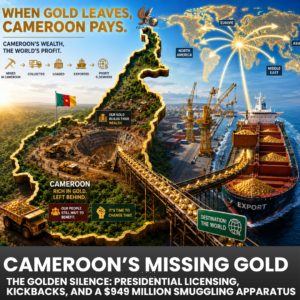 Oil is not the only extractive sector through which the Biya system has monetised state power. The gold sector tells an equally damning story, and the numbers are, if anything, more staggering.
Cameroon is endowed with significant gold deposits, concentrated primarily in the East and Adamawa regions. The country has no industrial-scale gold mines in operation. Instead, the sector is dominated by artisanal and semi-mechanised operations, a structure that, under normal regulatory conditions, would produce modest but traceable revenues. Under the Biya system, it has produced something else entirely: a parallel economy of licensed extraction, unlicensed exploitation, and systematic diversion of gold to international markets, with the state functioning simultaneously as regulator, enabler, and beneficiary.
The numbers that expose this system come not from a whistleblower or a leaked document, but from the Cameroonian government’s own submission to the Extractive Industries Transparency Initiative. The EITI’s 2023 report found that Cameroon officially declared producing 953 kilograms of gold, with just 22.3 kilograms formally exported through official customs channels.
“Importing countries recorded receiving 15.2 tonnes of Cameroonian gold in 2023 — nearly 680× the declared export figure. More than 90% flowed to the UAE. Estimated fiscal losses: CFA 165 billion (~$274 million) in a single year.”
The Licensing Architecture and Its Corruption
Under Cameroon’s mining code, every meaningful authorisation in the gold sector flows through institutions under direct presidential control. Industrial mining permits require Prime Ministerial endorsement. Large-scale exploitation permits require a presidential decree. Semi-mechanised artisanal mining authorisations, covering the majority of active gold extraction, are issued by the MINMIDT minister, a presidential appointment.
This architecture creates a system in which mining licenses are, in practice, a form of presidential patronage. Obtaining an exploitation permit requires access to the political network around Biya. That access has a price. Multiple sources referenced in governance reports describe a well-understood informal tariff: a percentage of anticipated production paid upfront as a kickback to intermediaries with access to the presidency, in exchange for the ministerial endorsement that makes a license legally operable. The presidency has never publicly addressed these allegations.
The scale of the licensing problem became impossible to ignore in May 2026, when the Ministry of Mines published a list of nearly 200 illegal gold mining companies operating without valid permits and ordered their immediate closure. More than 95% were foreign-owned, many run by Chinese nationals. Mines Minister Fuh Calistus Gentry framed the crackdown as an effort to ‘regain control over gold production and marketing.’ What went unaddressed was how 200 companies had operated at industrial scale, in full view of state officials, without valid authorisations.
Researcher Aicha Pemboura was direct: despite Cameroon’s new 2023 mining code, ‘corruption and the influence of powerful elites still limit enforcement.’ A joint inspection mission found that many authorisations had been issued without prior review by the Inter-ministerial Commission for the Examination of Mining Titles, as required by Prime Ministerial Order. Permits were signed outside the mandated process. That is not bureaucratic error. It is a parallel licensing system operating beneath the formal one.
Dubai, the Wagner Route, and the Cameroonian Corridor
The destination of Cameroon’s missing gold is not accidental. SwissAid’s November 2025 report documented the UAE importing 748 tonnes of African gold in 2024, an 18% increase year-on-year. Research by The Sentry and the Global Initiative Against Transnational Organized Crime has documented that CAR gold, where the Wagner Group controls significant mining operations, moves westward through Cameroon toward Dubai. Field data collected by the Institute for Security Studies in December 2025 confirmed that armed groups, clandestine intermediaries, and corrupt government officials control supply chains across the Cameroon-CAR border region. The East region, where most illegal companies were identified, borders CAR directly. Once gold enters an informal trader’s hands there, provenance is effectively untraceable.
SONAMINES: Reform or Cover?
In 2020, the government created SONAMINES with a mandate to centralise gold purchasing and formalise the sector. The stated objective was to close the gap between production and declared exports, bringing artisanal miners into a structured supply chain that would give the state visibility over revenue from gold flows. By 2025, SONAMINES had transferred 638 kilograms of gold to the state. The figure was presented as a success.
The EITI’s 2023 data told a different story. Of the gold collected by SONAMINES, 269 kilograms was not clearly accounted for in public finances. The institution created to fix the transparency problem had replicated it. SONAMINES had not replaced the informal system; it had added another layer of opacity to it. A state-owned gold buyer with unexplained inventory shortfalls is not a reform. It is a formalised continuation of the same diversion dynamic, now with government letterhead.
The pattern is consistent with what transparency researchers have identified across African resource sectors: state capture does not end when formal mechanisms are created; it migrates into them. Institutions designed to restore accountability become nodes of rent extraction in their own right, particularly when political appointees control their operations and audit functions remain toothless.
The Commission of Inquiry and Its Limits
In early 2026, President Biya ordered the creation of a mixed commission of inquiry to investigate illegal gold trafficking networks. The directive, transmitted through Minister of State Ferdinand Ngoh Ngoh, instructed authorities to identify networks and assign responsibilities. The announcement was welcomed by some observers as a sign of political will.
The sceptics had reason to be cautious. The presidential inquiry was announced not in response to civil society pressure or investigative reporting, but after the EITI, a multilateral body to which Cameroon is a voluntary signatory published data that made the scale of the gap undeniable. The inquiry is reactive, not proactive. Its mandate does not extend to examining how the licensing system itself created the conditions for mass evasion. And the commission’s conclusions will be transmitted to the same presidency whose political network the evidence suggests is implicated in the system being investigated.
Researcher Pemboura’s assessment captures the structural problem: the 2023 mining code contains the right provisions on paper. What it lacks is a chain of enforcement that operates independently of the political system those provisions are supposed to constrain. Without an independent judiciary, a free press with protected sources, and a civil society able to operate without harassment, codes are decorative. The commission of inquiry will produce a report. Whether that report will name names, assign liability, and result in prosecutions is a different question entirely.
The Statement That Read Like a Confession
President Biya, December 31, 2024: “I am convinced that controlling the marketing channels of our minerals will increase the financial resources needed to carry out our development projects.”
The statement, delivered in Biya’s year-end address to the nation, reads as an aspiration for the public record. Those familiar with how the presidential licensing system has operated for four decades read it differently: as an acknowledgement that the channels have, until now, been controlled by someone other than the state. The passive construction is telling. Biya does not say who controls the marketing channels now, or why they have been allowed to operate outside state visibility for so long. He simply indicates his conviction that this should change.
For a president in his ninth decade and his fifth decade of rule, a tenure that places him in the company of Africa’s most entrenched long-serving executives, a cohort Global Echos has examined across the continent, the statement functions simultaneously as reform rhetoric and as the latest in a long sequence of declarations that have never been backed by structural accountability. The gold sector alone tells the story in one statistic: $949 million worth of Cameroonian gold reached the UAE in 2023, while the official customs record showed 22.3 kilograms. That is not a bureaucratic discrepancy. It is a system.
What Accountability Would Actually Require
Genuine reform in Cameroon’s gold sector would require several things that the current political settlement makes extremely difficult. It would require an independent audit of SONAMINES’ books, with findings made public and discrepancies referred to a genuinely independent special criminal court. It would require revoking the licences of operators who obtained authorisations outside the mandated Inter-ministerial Commission process, and publishing the names of both the operators and the officials who signed off on those permits.
It would require Cameroon’s international partners, like the IMF, the World Bank, and bilateral donors to make resource transparency a condition of continued support, rather than treating extractive sector governance as a domestic political matter. And it would require pressure on the UAE to implement the gold import due-diligence standards it has repeatedly committed to in international forums but has not enforced in practice. African gold washing through Dubai is not a Cameroonian problem alone. It is a global governance failure, enabled by the same gap between stated commitments and enforcement that defines the Biya system at home.
Until those conditions obtain, the commission of inquiry will report, the licensing system will continue, the gold will keep moving, and the 680-fold gap between what Cameroon declares and what the world receives will remain the most precise measure available of the distance between the state and its people.

Les camerounais ont fait quoi pour mériter ça, mon Dieu